





 Log In
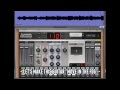
EARebound is a full-featured multi-delay plug-in which has been designed to meet a specific need : to quickly create rhythm lines from percussive sounds recorded in various environments (natural, urban, industrial, …).
Recording these sounds, processing them through (carefully selected) effects in order to obtain multiple versions of them, loading and mapping them in a sampler, placing them in space, … takes a considerable amount of time and can be an obstacle to spontaneous creativity. In addition, even if we are satisfied with the results after hours of hard work, this rhythmic grail cannot be easily modified, as we would like, during live situations.
A first prototype of this thing was then born in 2011, offering 16 steps (the input + 15 delay lines) being processed by a dedicated set of shaping and positioning tools. The workflow was already similar to the one provided by a good old drum machine and it was enough to create rhythm lines from any kind of recorded sounds within a couple of minutes… lots of fun and saved time!
Great… but considering that not everyone shares my pathological obsession for environmental percussive sounds, it would have been a shame to keep EARebound as-is because it obviously has the potential to evolve into a more universal, easy to use and definitely ultra-creative product…
Apart from any situation where a solid delay unit is needed, EARebound is now particularly useful when it comes to create rhythm from any material or instantly enhance an existing audio loop.
16 delay lines
The input signal and the 15 first delay lines provide 16 steps - as you can find on most vintage beat boxes.Each of these “steps” is processed by its own set of effects (saturation, filters, modulation, …).
By default, delay times match the 16th notes of a 4/4 bar and everything is synchronized to the host tempo (of course, you are free to change these delay times as you wish).
If we forget about the multiple feedback parameters (one per delay line), all of this may sound like a set of tweaked “tape heads” or the 16 pads of a vintage beat box…
Finally, an extra “global” delay line is available to make your “pattern” loop the way you want. By using a short delay time, you can also use it to create very special effects.
As other delay lines, the “global delay” has its own set of effects…
Three pairs of stereo outputs
The name of these output pairs is quite explicit: Main, Aux, LFE.
However, even if you don’t plan to work on surround projects, these outputs aren’t just there for the sake of “gadget” appeal.
When using a multi-tap delay, we usually like to add some “diffusion” to some taps or we would like to process some of them with another effect (which is not necessary a reverb).
If you already love a reverb it may be interesting to apply it on the taps of your choice instead of using an integrated basic verb - don’t you think? The “Aux” output combined with 2D position tools are what you need to use your favorite reverb (or 3D positioning effect) as if it was “integrated” to EARebound.
The LFE output can then be used to split low frequencies and send them to a subwoofer… But the “Split LF” section of EARebound has more to offer.
Low frequencies
A multi-delay has the potential to “spread low frequencies everywhere” which is usually not something our ears will appreciate…
Basically, LF can be responsible for a muddy mix if they are not properly handled.
The “Split LF” section of EARebound will help to easily avoid such annoyances by “monoizing”, reducing, or even cutting low frequencies. You can decide to do it after or before they enter delay lines.
And even if you don’t want to send LF to the dedicated “LFE” output, the “Split LF” section will work in stereo mode.
Presets and Random feature
EARebound offers a selection of categorized presets which have been designed to get you started with the plug-in.
The presets manager offers the possibility to quickly save, sort and recall your own presets.
Should you be in a hurry for instant creativity, just press the “Random” pad to generate your own presets. Pressing this pad will not just blindly turn knobs and push buttons for you… You can define your own rules so the results match your needs.
Switching from a preset to another or pushing the “Random” pad will just trigger a smooth process during which EARebound will do its best to avoid pops, clicks and other artifacts. This is why it is also possible to perform such actions right in the middle of a tune or during live situations.
Workflow
EARebound includes 16 delay lines (each featuring a feedback parameter and a specific delay time), 17 saturation units, 17 modulation modules, 34 “cut” filters, 17 positioning tools, 1 crossover, various gain/mix/send faders, …That makes almost 400 parameters to deal with!
The interface, however, should help to simplify this. Three different views are available…

The “Main View” provides an access to all parameters, including global ones (input and send level, dry/wet mix, LF section, …). For parameters related to a specific “line”, you just select the line to tweak its effect section with precision.

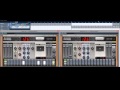
The “Mix View” offers an overview of the effects applied to the “source” and the 15 first delay lines. It is perfect when you need to adjust a same effect on all 16 elements.

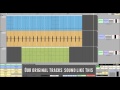
The "Time Line" offers an overview of the delay time applied to each of the 15 first delay lines. It is very convenient for setting delay times in relation to one other.
Using the graphical interface during live situations is probably not your best bet, though…
MIDI Control *
Even if parameters can be automated from most software hosts, EARebound features a MIDI input which provides an alternative way to control the plug-in… and the lightning-fast MIDI Learn procedure should be enough to get the whole thing under control in no time!
* EARebound is a VST/AU effect with a MIDI Input. How easy or difficult (or even possible) it is to make use of this MIDI input depends on the host. Please consult your DAW’s manual for more information about it.
System Requirements
PC
- Operating system: Windows XP, Windows Vista or Windows 7 (32 or 64 bits)
- Processor: Pentium IV or Athlon (minimum)
- RAM: 1Gb (recommended)
Mac
- Operating system: Mac OSX (10.5 or later)
- Processor: Intel Core 2 Duo (minimum)
- RAM: 1Gb (recommended)
Awards
Installation
To install your eaReckon software please follow the steps. (For demonstration purposes we are using EARverb)
1. Open up the installer that is available in your Plugin Boutique User Account once purchased.
2. Read through the License Agreement and select Next to continue.
3. Choose where you would like install your software.
4. Go to this URL - www.eareckon.com and register an account with eaReckon in order to receive your Challenge Response code.

5. Select the Products Registration tab.
6. You will now need to register the serial number that is available in your Plugin Boutique User Account and purcahse confirmation email.

7. Launch the EAReverb in your preferred DAW and you shall see a Hardware ID number.

8. Go to the Products Registration page at www.eareckon.com and register your Hardware ID to receive your Authorization Code.

9. Once the Authorization Code is generated go back to your loaded up software and enter your serial number (available in your eaReckon, Plugin Boutique Account and purchase confirmation email) and enter the generated Authorization Code that has just been generated in your eaReckon account.


